For any publisher who wants to remain a 'player' in the highly competive business of specialized publishing, it's sometimes necessary to 're-invent' their formats. The casual reader, with an interest in military history or a passing interest in military vehicles is unlikely to look for books by Jentz in the shelves of their local Borders but rather to look for something which is both general and specific to their interest. In this, Osprey Publishing has been doing an excellent job by continuing to produce books for both the 'hardcore' specialist and the occasional purchaser of military history books.
However, there has long been a need for a company like Osprey to 'bridge' the divide for the enthusiast by looking at both the tactical situation and the 'hardware' of a specific conflict. In this, they have created a completely new series entitled 'Duel' which will deal with two opposing sides' specific hardware in a particular historical period. In the case of this book, in Normandy 1944, in others, tank vs. tank on the Eastern Front.
The book - basics
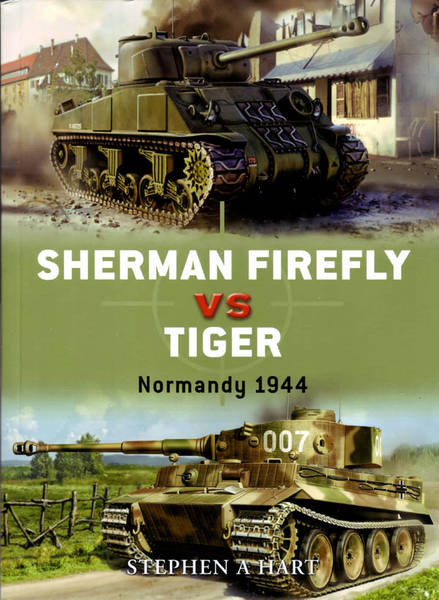
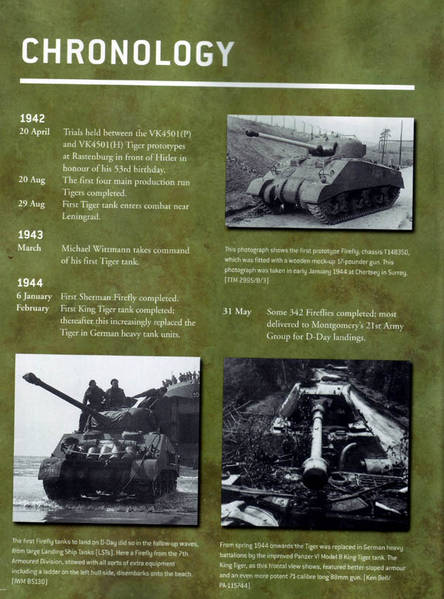
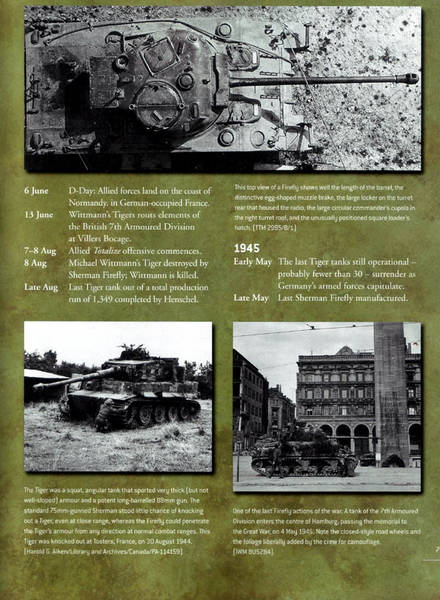
Sherman Firefly vs Tiger (Normandy 1944) is an 80 page, softcover book written by Stephen A Hart. The book consists of ten chapters and is illustrated throughout with both contemporary images and commissioned color plates and maps which were done by Jim Laurier and Howard Gerrard. The book, is due for publication on 10 September 2007 (Britain) and 18 September 2007 (U.S.A.). For those who require it, the book carries the ISBN 13:9781846031502
In More detail
Roughly speaking, the book can be described as dealing with the following areas:
1) The technical: Both vehicles are given a overview of their development, technical specifications and (where necessary), notes on variants.
2) The Stategic Situation: The situation as it was in august 1944 is summarized - at this point, the long expected breakthrough had begun (particularly on the part of the Americans) and the decisive battle of the Falaise 'Pocket' was about to begin.
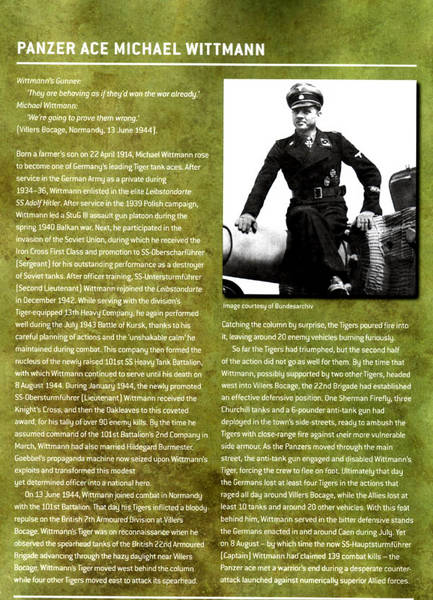
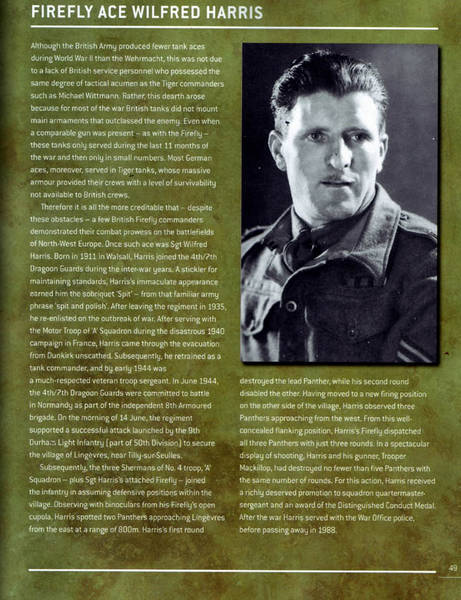
3) The Combatants: This chapter covers an area which is frequently overlooked - the preparation, morale and the daily life of the troops. Within this section are also short biographical details of three of the 'Aces' involved in this campaign - Otto Carius, Michael Wittmann and (unusually enough!) Wilfred Harris who destroyed 5 Panthers with 5 17 pounder rounds.
4) The Action: This section specifically deals with 'Operation Totalize' - the Allied actions and the German response. Included in this chapter are details of the advance of Wittmann's troop and the subsequent combat with Firefles and Shermans of the Sherbrooke Fusiliers. Several specifics of 'Totalize' are dealt with here - The battle for Le Petit Ravin, and the advance to St. Aignan. Inevitably of course, there is a sub-chapter dealing with the death of Wittmann. The author gives credit to a Firefly gunner - Trooper Joe Ekins and, like much of the recent research, discards the 'Typhoon' explanation.
5) Analysis of the Battle consists of a series of photos taken afterwards along with the inevitably grim statistics of the loss of life.
6) Aftermath: In the final three pages of analysis, the author looks at the later results of Operation Totalize which was to culminate the German disaster in Falaise. He also, quite correctly, analyzes the Firefly as an effective although interim vehicle and also identifies the battles in Normandy as the 'Finest Hour' of the tank. As to the Tiger, with the effective use of the Firefly, and factors such as total Allied control of the air and facing overwhelming oppposition, it's supremacy on the battlefields of the Western Front effectively ended.
7) Bibliography: The last two pages cover a very useful list of other publications. All the 'standards' are there - Jentz on the Tiger, Mark Hayward on the Firefly etc. Added to this however are some interesting unpublished sources which are primarily war diaries of units which took part.
Conclusions
At the outset, I must admit to a certain degree of 'nervousness' as to whether this could be a 'populist' title which would add little to the currently available material. Even though a lot of the material is familiar to me, I got a great deal from the book. There are a number of issues however as to this kind of book which i'll try and address here:
As I said in the introduction, any publisher has to walk a path between what is 'commercial' and what will only appeal to a very specialized market. This, in my opinion, is an excellent book for anyone who wants to go beyond the nuts and bolts of a vehicle and look at its actual use in combat. It deals with the (frequently ignored) human factor along with the 'grand scale' of strategic planning. For the Modeller or the History Buff? In my opinion, it gives a good deal for both. I hold the opinion that ignoring the 'context' of a vehicle within history is short-sighted. That as modellers we should look for inspiration in a wide number of areas, it's not, IMO, an isolated lump of metal which existed in a vacuum. In that respect, it fulfis my (personal) criteria by putting the Tiger and the Firefly in the enivornment they were designed for- the battlefield. So books for those with an interest in history should also be used by modellers. Use of Illustration: There are some really good graphics in the book. Although it might seem a little 'gimmicky' I liked the visualization of what Trooper Ekins (probably) saw when he engaged '007'. The photos are good but, once again, serve as illustrations rather than references - putting the reader in the 'context'. The author also uses the 'After the Battle' approach by looking at the battlefield decades later and giving the reader a good feel of what the crews probably saw in august 1944. The Text: There's a lot more text than images in this book. The author has a good style of writing which keeps the reader involved. At no point does this degenerate into another of these dry technical manuals. By reasons of space and the nature of the book, the technical notes on the two vehicles are sufficient to introduce the protagonists - for the in-depth studies of the Firefly and Tiger, Hayward and Spielberger are widely available! The Series: It's difficult to judge a new series with a very original format on the basis of one book. However, Osprey Publishing with the 'Duel' series have really hit the ground running with this book. It's original it makes a nice change to other formats and should sell well. I would consider that those who'll get more out of it are those who, as yet, don't have very extensive reference libraries although most modelers will (if they choose to) get a great deal out of it. Highly Recommended
SUMMARY
The first (armor) title in a completely new series from Osprey Publishing, this promises a very different approach to reference material dealing with both the technical details of the vehicles along with the tactical environment and the (too often forgotten) human element.
Our Thanks to Osprey Publishing! This item was provided by them for the purpose of having it reviewed on this KitMaker Network site. If you would like your kit, book, or product reviewed, please contact us.
About Jim Rae (jimbrae) FROM: PROVINCIA DE LUGO, SPAIN / ESPAñA
Self-employed English teacher living in NW Spain. Been modelling off and on since the sixties. Came back into the hobby around ten years ago. First love is Soviet Armor with German subjects running a close second. Currently exploring ways of getting cloned to allow time for modelling, working and wr...
Very good summary of this new title. I am not overly fond of white type on colored backgrounds (readability suffers IMHO) but the contents as described more than makes up for this.
Very good summary of this new title. I am not overly fond of white type on colored backgrounds (readability suffers IMHO) but the contents as described more than makes up for this.
The cover image shows a Tiger numbered "007", presumably Michael Wittman's.
It's painted as an "early" Tiger with drum cupola.
But the photographic record proves it was a "Late" with different turret and wheels. In fact you can buy model kits that represent it better than this.
David






Comments